Heat Illness Prevention Training
California · Online · about 30 minutes
This course covers Cal/OSHA's heat illness rules: water, shade, cool-down rest, getting used to the heat, high heat, signs and first aid, and emergency response.
- 8 short lessons. Supervisors get a 9th lesson.
- A quick check question at the end of each lesson.
- A final quiz. You need 80% to pass. You can retake it as many times as you need.
- When you pass, send your results to your employer or print your training record.
Dashed boxes marked At your worksite list things your employer has to tell you about your own job. Ask your supervisor about each one.
For employers: how to use this course
What it covers
The employee training topics in §3395(h)(1)(A) through (I), the supervisor topics in §3395(h)(2) (lesson 9), and an overview of indoor heat under §3396. Training has to happen before work that could reasonably expose a worker to the risk of heat illness.
What you still provide
- Your written Heat Illness Prevention Plan, in English and the language most of your workers understand, available at the worksite.
- Your own procedures. Several training topics are your company's procedures: water and shade, acclimatization methods, high-heat observation and the designated 911 caller, how emergency services are reached, and how responders get directions to the site. The course teaches the rules and tells workers to ask about these. Review them with each worker before work starts. The training record has a sign-off line for it.
- Training in a language your workers understand. This version is in English.
- Someone workers can ask questions. Add a contact in the file's settings or point them to their supervisor.
- Indoor work at 82°F or above falls under §3396, which has its own assessment and control requirements beyond this overview.
Getting results
When a worker passes, they can email the results to the address you set in the file's settings (open the file in a text editor and find CONFIG), or type in an address. They can also print or save a training record. Cal/OSHA recommends keeping records of this training.
Answer key
The quiz checks answers inside the file, so the key is in the file's code. Each topic has two versions of its question, and a retake switches versions.
1. Why heat matters
About 2 minutes
Heat illness can start with a headache or cramps and turn into heat stroke in the same shift. Heat stroke can kill. Most cases can be prevented with water, shade, rest, and people watching out for each other.
The rules
- Outdoor work: Title 8 §3395. Covers every outdoor workplace in California. Agriculture, construction, landscaping, oil and gas extraction, and some transportation and delivery work also have to follow the high-heat procedures at 95°F (lesson 6).
- Indoor work: Title 8 §3396. Covers indoor work areas once they reach 82°F with people working. It requires water, a cool-down area kept below 82°F, cool-down rests, and the same training and emergency response. At 87°F (or 82°F for workers in clothing that traps heat or near a strong heat source), the employer also has to cool the area or limit exposure.
The outdoor temperature triggers
Drag the slider to try any temperature.
Temperatures are measured in the work area. Lesson 2 explains how.
Your employer's plan
Every employer with outdoor workers has to have a written Heat Illness Prevention Plan. It covers water, shade, high heat, getting used to the heat, and emergencies. It has to be in English and in the language most of the workers understand, and available at the worksite.
Your rights
You have the right to water, shade, a cool-down rest when you need one, and first aid. You can use these rights without being disciplined or punished for it. Retaliating against a worker for using them is against California law.
- Where is the written Heat Illness Prevention Plan kept?
2. What raises your risk
About 4 minutes
Your body makes heat when you work. In hot conditions it cools off mostly by sweating. Heat illness happens when your body takes on more heat than it can get rid of.
Conditions at work
- High air temperature
- High humidity, which keeps sweat from drying and cooling you
- Direct sun, and heat coming off pavement, roofs, metal, equipment, and engines
- Hot ground, pavement, or metal you kneel, sit, or lie on
- Little air movement, like in trenches, attics, greenhouses, and tight spaces
- Heavy work, and how long you keep it up
- Clothing and PPE
Things about you
- Age and overall health
- Whether your body is used to the heat (lesson 5)
- How much water you've been drinking
- Alcohol, especially the night before
- Caffeine, including energy drinks
- Prescription medications that affect how your body holds water or handles heat
Poor sleep and a recent illness with fever, vomiting, or diarrhea also raise your risk.
If you take medication, ask your doctor or pharmacist whether it affects how you handle heat.
PPE and hard work add heat
Hard work builds heat inside your body. Coveralls, chemical suits, rain gear, respirators, and welding gear trap that heat and keep sweat from drying. A worker in protective coveralls doing heavy work can overheat on a day that doesn't feel very hot.
Wear the PPE the job requires. When you're in it, plan on more water and more cool-down rests. Where the job allows, light-colored, loose, breathable clothes help.
Tap to turn each one on or off. This shows how the factors add up. It isn't a measurement.
How temperature is measured
Cal/OSHA's outdoor temperatures (80°F and 95°F) are taken in the work area, in full sun, with the thermometer's sensor shaded by a hand or an object. The forecast for town doesn't decide it. A trench, a roof, or a field can run hotter than the forecast.
3. Water
About 3 minutes
Water is your first defense against heat illness.
What your employer has to provide
- Free, fresh, pure, and suitably cool drinking water.
- Close to the work. Water has to be as close as practicable to where you're working.
- Enough for the whole shift. At least 1 quart per person per hour. If the day starts with less, it has to be refilled before it runs out.
How to drink
- Drink small amounts often. When it's hot and you're sweating, aim for up to 4 cups an hour. That's about 1 cup every 15 minutes.
- Don't wait until you're thirsty. By then you're already behind.
- Start the day hydrated. Drink water before your shift.
- Eat your meals. Food helps replace the salt you lose in sweat.
- Go easy on alcohol the night before, and on energy drinks and heavy caffeine during hot work.
Speak up
If the water is low, warm, dirty, or too far from your work, tell your supervisor right away. Don't wait for it to run out. Use your own bottle or single-use cups. No shared cups.
- Where is the drinking water?
- Who refills it, and how do you let them know it's low?
4. Shade and cool-down rest
About 4 minutes
When shade is required
- Over 80°F: shade is set up and kept up the whole time workers are on site.
- 80°F or below: shade is either set up, or provided quickly when you ask for it.
What the shade has to be
- Big enough for everyone on a rest break to sit normally, fully in the shade, without touching each other
- At meal breaks, big enough for everyone who eats on site
- As close as practicable to where you're working
- Open to the air, or ventilated or cooled
- Safe and easy to get to
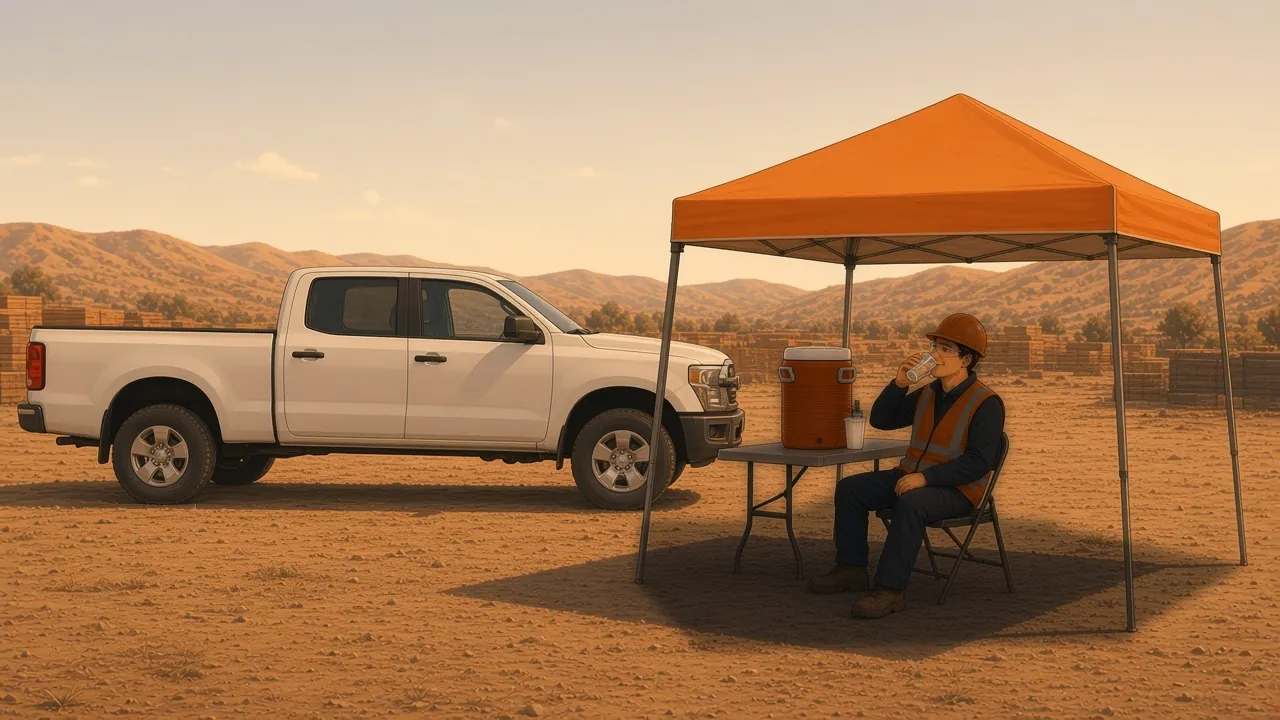
Good shade blocks the sun completely. Things inside it don't cast a shadow.
Doesn't count as shade: a car or truck sitting in the sun with the engine off. A vehicle only counts if it's running with the air conditioning on. A spot that puts you in danger, like under parked equipment or at the edge of an excavation, doesn't count either.
Cab temperatures use the average rise measured in parked cars on warm days (McLaren and others, Pediatrics, 2005), starting from 85°F outside. Cracking the windows barely slows it down.
Cool-down rest
You can take a preventative cool-down rest in the shade any time you feel you need one to keep from overheating. You don't have to wait for a scheduled break. Let your supervisor or a coworker know you're taking one.
- At least 5 minutes in the shade, not counting the time it takes to get there.
- Your supervisor or a designee checks on you and asks how you feel.
- You're encouraged to stay in the shade.
- You can't be ordered back to work until any signs or symptoms are gone.
- If you have symptoms during the rest, first aid starts right away (lesson 7).
- Where is the shade, or the cool-down area if you work indoors?
- On cooler days, how do you ask for shade?
5. Getting used to the heat
About 3 minutes
Acclimatization is your body adjusting to work in the heat. It happens a little at a time. For most people it takes 4 to 14 days of working in the heat at least 2 hours a day.
Once you're used to it, you start sweating sooner and handle the heat better. You can lose that after about a week away from hot work.
An illustration of the general pattern. Everyone adjusts at a different pace.
Who's at highest risk
- New workers in their first days on a hot job. Many heat deaths happen in a worker's first few days.
- Workers coming back after a week or more off, or moving from cooler work.
- Everyone during a heat wave.
Heat wave
Cal/OSHA defines a heat wave as a day when the predicted high is at least 80°F and at least 10°F hotter than the average high of the past 5 days. A sudden hot spell can catch even experienced workers.
What the rule requires
- A worker newly assigned to a high-heat area is closely watched by a supervisor or designee for the first 14 days.
- During a heat wave, all workers are closely watched by a supervisor or designee.
Many employers also start new workers with lighter work and more breaks, and schedule the heaviest work for cooler hours.
Your part: pace yourself the first few days, keep drinking water, take cool-down rests, and speak up early.
- How does your employer help new and returning workers get used to the heat?
- Who watches new workers during their first 14 days?
6. High heat: 95°F and above
About 3 minutes
When the temperature in the work area reaches 95°F or higher, high-heat procedures start. They're required for agriculture, construction, landscaping, oil and gas extraction, and transportation or delivery of agricultural products, construction materials, or other heavy materials. Other employers can use them too.
- Pre-shift meeting. Before work starts, the supervisor reviews the high-heat procedures, reminds everyone to drink plenty of water, and reminds everyone of the right to take a cool-down rest. A good meeting also covers how workers will be watched and who calls 911.
- Contact with a supervisor. You can reach a supervisor by voice, sight, radio, or phone. A cell phone only counts if reception at the site is reliable.
- Watching for heat illness. Everyone is watched for alertness and signs of heat illness, using one or more of these:
- A supervisor or designee watches a group of 20 or fewer
- A mandatory buddy system
- Regular check-ins by radio or phone with anyone working alone
- Another effective way of watching workers
- Designated 911 caller. One or more people on each site are named to call for emergency medical services. If none of them is available, anyone can call.
- Water reminders through the whole shift.
Agriculture only: at 95°F or above, each worker also takes a 10-minute preventative cool-down rest every 2 hours. It can line up with a regular rest or meal break.
If you're on the buddy system
Know where your buddy is. Check on each other often. Watch for confusion, stumbling, unusual tiredness, or a change in how they talk or act. If something seems off, act on it right away.
- How are workers watched in high heat: supervisor, buddy system, or check-ins?
- Who is the designated 911 caller?
7. Signs, symptoms, and first aid
About 6 minutes
Heat illness includes heat cramps, heat fainting, heat exhaustion, and heat stroke. It can move from mild to life-threatening quickly.

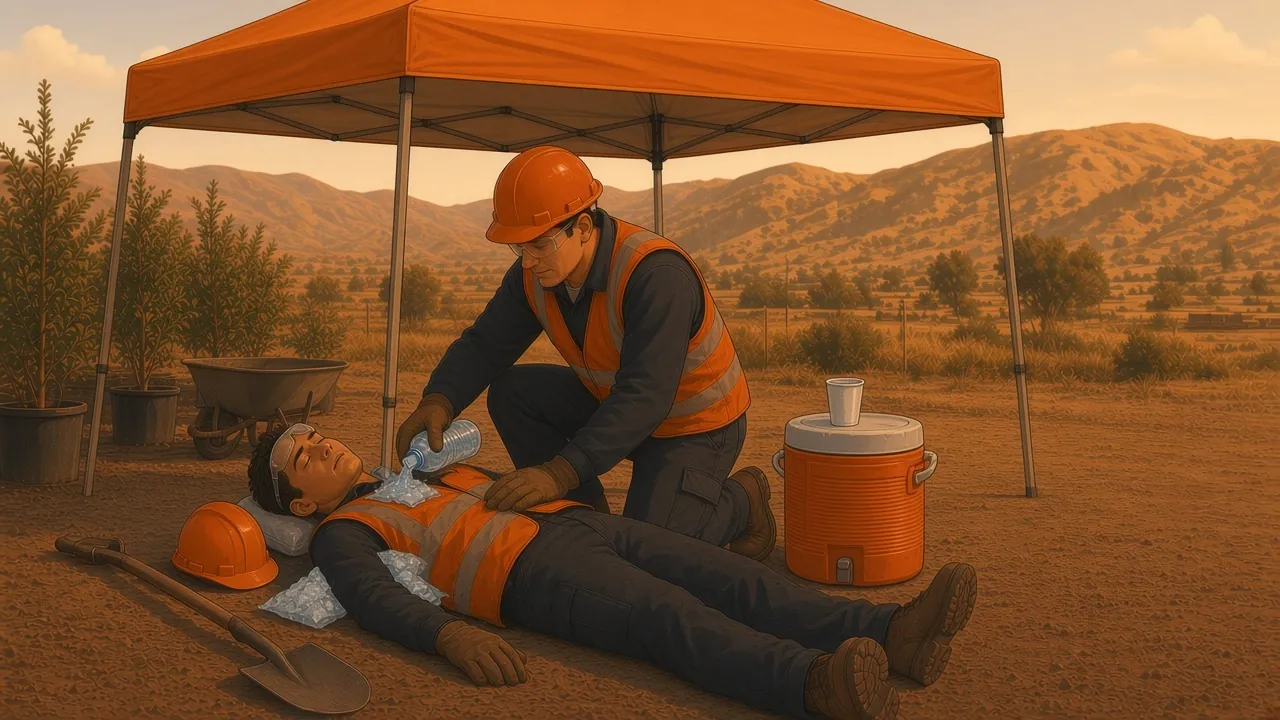
What to do:
Heat illness doesn't always follow these steps in order. A worker can go straight to heat stroke.
Heat cramps
Heat fainting (heat syncope)
Heat exhaustion
Heat stroke: medical emergency
Also watch for rhabdo (rhabdomyolysis), a breakdown of muscle linked to heat and hard work. Signs are muscle pain or cramps, weakness, and dark urine the color of tea or cola. Report it. It needs a medical check.
Emergency signs. Call 911:
- Less alert, drowsy, or passing out
- Staggering
- Vomiting
- Confused or doesn't know where they are
- Acting irrational
- Seizures (convulsions)
Rules for everyone
- Don't try to diagnose. The signs overlap. If someone shows any signs, start first aid and get the supervisor.
- Never leave them alone. A worker with signs or symptoms is watched the whole time.
- Don't send them home. No one with signs of heat illness is sent home without first being offered first aid or emergency medical care.
- Report right away. If you notice signs in yourself or a coworker, tell your supervisor immediately, or report directly to your employer. Early reporting keeps mild cases mild.
8. Emergency response
About 3 minutes
Every employer has to have emergency procedures for heat illness. They follow these steps.
- Act right away. The worker stops working and moves to shade or a cool area. The supervisor acts based on how serious it is.
- Call 911 for emergency signs. Confusion, staggering, vomiting, passing out, or seizures. The designated caller makes the call. If they aren't available, anyone can call. Don't wait for permission.
- Give clear directions. Tell the dispatcher the site address, the nearest cross street, which gate or entrance to use, and any landmark. Send someone to the entrance or the road to meet the ambulance and lead it in.
- Get the worker to EMS if needed. If an ambulance can't reach the work area, the worker is moved to a point where EMS can reach them, as directed by the supervisor or the 911 dispatcher.
- Keep cooling and stay with them until EMS takes over. Tell the responders what happened and what first aid was given.
If cell service at the site isn't reliable, the employer has to set up another way to call for help, like a radio, before work starts.
- The site address and how an ambulance gets in
- Who is designated to call 911, and who makes sure the emergency steps get followed
- Where the first aid kit is
- How to reach your supervisor, and the backup if cell service is poor
- Who to report to after an emergency
9. Supervisors
About 4 minutes
Supervisors carry out the heat plan on the job. You need everything in lessons 1 to 8, plus the following.
Watch the weather
- Check the forecast for the work location the day before and the morning of. Use weather.gov or a reliable weather app.
- Watch for National Weather Service heat alerts: Heat Advisory, Extreme Heat Watch, and Extreme Heat Warning.
- Look for a heat wave: predicted high at least 80°F and at least 10°F above the average high of the past 5 days.
- Check the temperature in the work area during the day: thermometer in full sun, sensor shaded. If the work area reads hotter than the forecast, go by the work area.
When heat is coming
- Bring water for at least 1 quart per person per hour, or have a refill plan that keeps it from running out.
- Have shade ready before it passes 80°F.
- Schedule the heaviest work for cooler hours. Start earlier if you can.
- Plan close observation for new workers (first 14 days) and for everyone during a heat wave.
- At 95°F, hold the high-heat pre-shift meeting, set the observation method, and name the 911 caller.
- Cover heat in your pre-shift or tailgate meetings.
When someone takes a cool-down rest
- Let them take it. Don't discourage it.
- Check on them and ask about symptoms.
- Encourage them to stay in the shade.
- Don't send them back until symptoms are gone, and never before 5 minutes in the shade.
When someone shows signs
- Act right away, matched to how serious it is.
- Emergency signs mean a 911 call and emergency response.
- Never leave them alone or send them home without offering first aid or emergency care.
- Make sure responders get clear directions to the site.
- Report it under your employer's procedures.
- Your employer's procedures for carrying out the heat plan, responding to heat illness, and reporting it.
Final quiz
Answer every question, then press Submit. You need to pass. If you don't pass, you'll see which topics to review and can retake the quiz as many times as you need.
Topics to review
These are the topics you missed. Review the lesson, then retake the quiz. The retake has new questions on the same topics.
Acknowledgment
Send your results
Check the acknowledgment box first. Send needs an email address.
Email didn't open? Copy your results instead
Copy the text below and send it to your employer.
Before you work in the heat, make sure your supervisor has gone over the worksite items from the dashed boxes: water, shade, high-heat procedures, who calls 911, and the site address.