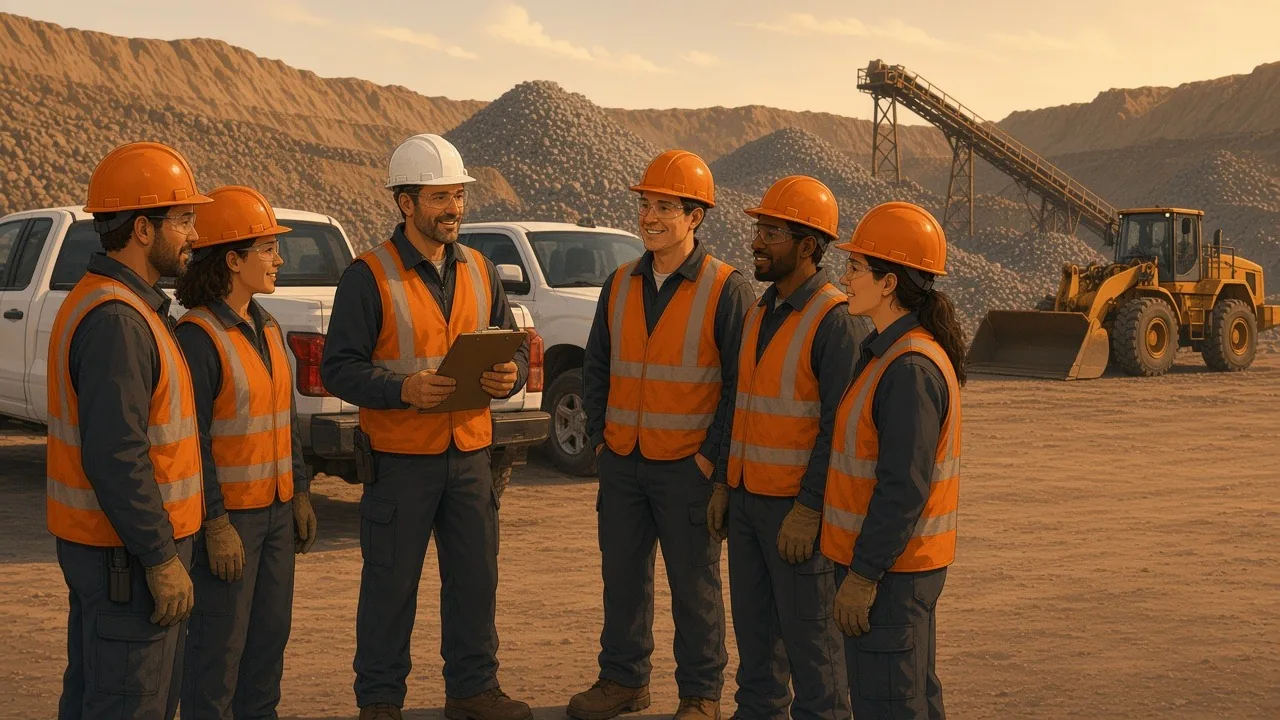
The online portion of Part 46 annual refresher training. Work through 13 modules at your own pace, each with an animated video, hands-on activities, and a short knowledge check. Then hand your record to your competent person.
Developed by Aaron Autsen, MSHA-approved instructor for surface mining operations since 2003.
Mine operators, contractors, and competent persons: read the Operator Guide before you assign this course. It explains what the course covers, what you still provide in person, and how to complete the §46.9 training record.
How your 8 hours fit together
Online, at your own pace§46.8(c) · at least 8 hours
Online13 modules on the subjects MSHA recommends, each with an animated video
OnlineReview rounds on your weakest modules until you reach 8 hours
OnlineA list of what's changed at your mine, for your competent person
In person, at your mine§46.8(b) · changes at the mine
In personChanges at your mine since your last refresher
In personYour mine's alarms, escape routes, lockout procedure, and HazCom program
In personAnswers to the questions you write during the course
Refresher training is due every 12 months. Task training for a new task or new equipment still happens at the mine before you do that task.
Welcome back
This clears all progress and answers saved on this device. Make sure the current trainee's record has been copied or printed first.
Already started?
Trainee information
Generic training content for 30 CFR Part 46 operations, checked against current regulations in October 2026. It does not replace instruction on changes at your mine, site-specific training, or task training, and it does not address any one mine's procedures.
§46.8 · How refresher training works, your rights, and changes at your mine
Your Annual Refresher
This module covers how annual refresher training works, why changes at your mine come first, your rights as a miner, and the MSHA rule changes you should know about this year.
How refresher training works
Every miner gets at least 8 hours of refresher training every 12 months.
Your first refresher is due within 12 months after you start work at the mine. After that, each one is due within 12 months of the last one you finished.
MSHA counts this by month. If you finished last year's refresher in March, this year's is due by the end of March.
The 8 hours can be split into sessions. Each session is recorded, and you get a certified copy of your record once the 8 hours are done.
Refresher training happens during normal working hours, and you're paid your normal rate for it.
Refresher training has to cover changes at your mine that could affect your health or safety. That's the part of this training that matters most, because a mine never stays the same for a year. Think about what's different since your last refresher:
New or rebuilt equipment, or equipment moved to a new area
A new pit, bench, haul road, stockpile area, or traffic pattern
New procedures, such as a new lockout procedure or radio protocol
New chemicals, new contractors on site, or new tasks you've been assigned
Accidents, injuries, and near misses at your mine, and what was changed because of them
This course can't know what changed at your mine. Your competent person covers that with you in person. The activity below helps you get ready for that conversation.
30 CFR §46.8(b)
Your rights, refreshed
Report a hazard
Anyone can report a hazardous condition to MSHA at 1-800-746-1553, 24 hours a day, or online. You don't have to give your name.
Request an inspection
You or your miners' representative can ask MSHA for an immediate inspection if you believe there's a violation or an imminent danger.
Refuse unsafe work
You can refuse work you reasonably and in good faith believe is unsafe. Tell your supervisor what the hazard is.
No retaliation
You can't be punished for raising safety concerns, reporting injuries, refusing unsafe work, or talking to MSHA. If it happens, you have 60 days to file a discrimination complaint with MSHA.
Training records
You get a certified copy of your refresher record after the 8 hours are done, and copies of your training records if you ask when you leave.
Mine Act §103(g) · §105(c) · 30 CFR §46.9
New tasks and new equipment
Refresher training doesn't replace task training. Before you do a task you haven't done before, or run equipment that's new to you, you get task training on its hazards, safe work procedures, and the standards that apply. That includes a new model of a machine you already run, if it operates differently. Ask for it.
30 CFR §46.7
MSHA rule changes to know about
Mobile equipment safety program
Surface mines with mobile equipment must have a written safety program for it. The program identifies equipment hazards, sets maintenance schedules, looks at new safety technology, and covers training. It's reviewed at least once a year, with input from miners. You can ask for a copy at no cost.
Workplace examinations
Each working place is examined before work begins in it each shift. You're told about hazards found in your area, and the record shows what was found and when it was fixed.
Respirable silica
MSHA issued a rule in 2024 that lowers the silica exposure limit. In April 2026 MSHA paused enforcement of that rule at metal and nonmetal mines while court challenges continue, so the older limits are being enforced for now. The way you protect yourself hasn't changed. Module 11 covers it.
30 CFR §56.23000–56.23004 · §56.18002
§46.8(c) · Mandatory standards, inspections, maintenance and repair
Standards for Your Tasks and Daily Inspections
You don't need to memorize the regulations. You do need to know the ones that apply to the work you do every day, and how inspections and repairs are handled at your mine.
Where the rules are
30 CFR Part 56
Safety and health standards for surface metal and nonmetal mines, including sand, gravel, and stone.
30 CFR Part 46
Training for miners at these mines, including this refresher.
30 CFR Part 47
Hazard communication: chemical labels, Safety Data Sheets, and the mine's HazCom program.
30 CFR Part 62
Occupational noise exposure and hearing conservation.
30 CFR Part 50
Reporting accidents, injuries, and illnesses to MSHA.
Standards you work with every day
Your work
What the standard requires
Running mobile equipment
Inspect it before use each shift. Wear the seat belt where there's rollover protection. Sound a warning before moving. Set the brake and lower attachments when parked. §56.14100 · §56.14130 · §56.14200 · §56.14207
Working around machinery
Moving parts that can injure are guarded, and guards stay in place while it runs. Repairs happen only with the power off and the machine blocked against motion. §56.14107 · §56.14112 · §56.14105
Electrical work
Only qualified persons work on electrical equipment, with the power off and locked out. §56.12016 · §56.12017
Heights and water
Fall protection where there's a danger of falling. Life jackets where there's a danger of falling into water. §56.15005 · §56.15020
Every job
Hard hat, safety-toe boots, and eye protection where those hazards exist. Workplaces kept clean and orderly. §56.15002 · §56.15003 · §56.15004 · §56.20003
Pre-shift inspections
Self-propelled mobile equipment is inspected before it's used on each shift.
Defects that affect safety are corrected in a timely way.
If a defect makes the equipment hazardous to use, it's taken out of service and tagged until it's fixed.
Defects that aren't corrected right away are reported to the mine operator and recorded.
An inspection only works if you do it the same way every time. Walk all the way around, look underneath, and test brakes, steering, horn, backup alarm, and lights before you move.
30 CFR §56.14100
Workplace exams
A competent person examines each working place each shift before miners begin work there. Conditions that could hurt someone are written down, the miners affected are told, and corrective action starts promptly. If the examiner finds an imminent danger, everyone is withdrawn from the area until it's fixed. Records are kept for at least one year.
The exam doesn't replace your own look. Conditions change during a shift.
30 CFR §56.18002
Maintenance and repair
Raised beds, buckets, booms, and blades are lowered or securely blocked before anyone works under them. A hydraulic cylinder alone isn't a block.
Before a tire is removed for repair, deflate it. Inflate repaired tires in a cage or with a clip-on chuck and a long hose, standing out of the path of the rim if it lets go.
Use the right hand tool for the job and inspect it first. Keep guards on grinders and saws.
Before welding or cutting, clear combustibles, have an extinguisher ready, and check tanks and lines for fuel or other flammables. Keep a fire watch when required.
Use lifting equipment rated for the load, and keep clear of suspended loads.
30 CFR §56.14104 · §56.14211 · §56.4600–56.4604
§46.8(c) · Transportation controls, communication, traffic, mobile equipment
Powered Haulage and Traffic
Powered haulage kills more miners than anything else. In 2025, 13 of the 33 miners killed in U.S. mines died in powered haulage accidents. This module refreshes the rules and habits that prevent them.
How powered haulage accidents happen
A large truck or loader runs over or into a pickup or a person on foot that the operator couldn't see.
Equipment goes over the edge of a road, bench, or dump point, often with the operator not wearing a seat belt.
Equipment rolls away because the brake wasn't set or the wheels weren't chocked.
A miner is caught in a conveyor. MSHA counts conveyors as powered haulage.
Brakes or steering fail on a grade.
2025 figures: MSHA data reported by Pit & Quarry, January 2026 (unofficial year-end count)
Traffic controls
Follow your mine's traffic plan: speed limits, right-of-way, one-way roads, and left-hand traffic where it's used.
Berms on elevated roads are at least mid-axle height of the largest equipment that normally uses the road. Dump points have a berm, bumper block, or similar restraint where a truck could overtravel.
A berm guides and warns. It won't stop a loaded truck at speed.
Report soft spots, washouts, low berms, missing signs, and dust that cuts visibility.
At night, make sure your lights work and are clean, and slow down where lighting is poor.
30 CFR §56.9100 · §56.9300 · §56.9301
Communication
Use the radio channel and call-outs your mine requires: entering a haul road, passing, approaching a loader, and stopping in a travel lane.
Say who you are, where you are, and what you're doing. Wait for an answer before you move.
Know the horn signals. A common set is one blast before starting, two before moving forward, and three before backing, but follow your mine's signals.
If your radio fails, stop in a safe spot and don't continue until you can communicate.
No phone use while operating equipment or driving on mine property.
Light vehicles and people on foot
Pickups and service trucks on haul roads use the lights, beacons, flags, and radio call-outs your mine requires.
Park where large equipment operators can see you, never in a travel lane or behind a parked haul truck.
Approach a loader or haul truck on foot only after positive contact and a signal from the operator, with the bucket down and brake set.
Customer drivers stay in their trucks in the load-out area unless your mine's rules say otherwise.
Technology helps, and it can fail
Many mines now use cameras, proximity detection, collision warning systems, and seat belt interlocks. Your mine's mobile equipment safety program looks at which ones to use. They help. They also get dirty, get bypassed, and fail. Keep cameras clean, report systems that don't work, and keep making positive contact the old way.
30 CFR §56.23003
§46.8(c) · Excavators, dozers, dredges, and other heavy equipment
Excavators, Dozers, and Dredges
MSHA lists excavators and dredges among the equipment tied to the most deaths and serious injuries. Dozers working stockpiles and surge piles carry their own risks. This module covers what to watch for around each one.
Excavators
Swing area. The counterweight swings out past the tracks. Anyone caught between it and the machine, a truck, or a wall can be crushed. Barricade the swing area where people work nearby, and stay out of it.
Positive contact. Before you approach on foot, get the operator's attention by radio or from where they can see you. Wait for a signal, with the bucket on the ground and the controls locked.
Quick couplers. After every attachment change, confirm the locking pin is fully engaged, using the manufacturer's check. A bucket that isn't locked can drop without warning.
Edges. Keep the tracks back from bench edges, pond banks, and excavations. Ground near an edge can give way under the machine.
Lifting. Lift loads with an excavator only when the manufacturer allows it, using its rated lift point and lift chart. Never lift people in a bucket or use a bucket as a work platform.
Moving and parking. Travel with the bucket low. When you leave the machine, lower the bucket to the ground and set the brakes and locks. On a grade, turn into a bank or chock it.
30 CFR §56.14206 · §56.14207 · §56.14200
Dozers on stockpiles and surge piles
A pile fed or drawn from below can hide a void. Material pulled out through a feeder or draw point can leave the surface bridged over an empty space. A dozer that breaks through can drop in and be buried with the operator inside.
Know where every feeder, draw point, and reclaim tunnel is under the pile you're working.
Don't push over an active draw point. Stop the feeders below before you work above them, following your mine's written procedure.
Wear the seat belt and keep the cab door closed.
At a dump edge, leave a berm, push material over the edge instead of following it, and know the slope limits for your machine.
Get on and off facing the machine with three points of contact. Never jump.
30 CFR §56.16002 · §56.9301 · §56.14130
Dredges and floating equipment
Wear a life jacket on the deck, walkways, pipeline, and skiff, anywhere there's a danger of falling into water.
Board from a secured walkway or a tied-off boat. Keep handrails in place and decks clear of hoses, cable, and spillage.
Stay out of the line of fire of winch cables, anchor lines, and spud cables under tension. A cable that parts snaps back with enough force to kill.
Lock out the cutterhead, pump, and winches before you clear a blockage or work on them. Pipelines can hold pressure and separate at the joints.
Keep power cables to the dredge protected, and report damage right away.
Don't work alone on a dredge without a check-in plan. Cold water can disable a strong swimmer within minutes.
Machinery was the second leading cause of mining deaths in 2025. Most of these accidents happen during cleanup, maintenance, and clearing jams, when someone works on equipment that wasn't fully shut down and blocked.
Guarding
Gears, sprockets, chains, drive, head, tail, and takeup pulleys, flywheels, couplings, and shafts that could injure someone are guarded.
Guards stay in place while the machine runs. They come off only for testing or adjustments that can't be done with the guard on, and then the person has to be protected from the moving parts.
A guard that's damaged, missing a section, or tied on with wire gets reported and fixed.
Unguarded conveyors next to travelways need emergency stop devices or railings.
30 CFR §56.14107 · §56.14109 · §56.14112
Lockout, tagout, and blocking
Repairs and maintenance happen only after the power is off and the machine is blocked against hazardous motion. Electrical work needs the power locked out with your own lock.
Tell the people affected.
Shut down with the normal controls.
Isolate every energy source: electrical, hydraulic, pneumatic, fuel, and gravity.
Put your own lock and tag on each disconnect.
Release or block stored energy. Block belts, raised parts, and material in chutes.
Try to start it, then return the controls to off.
When you're done, clear everyone, put guards back, and remove only your own lock.
At shift change, the incoming crew puts on their locks before the outgoing crew removes theirs. Contractors working on the same equipment lock out too.
30 CFR §56.12016 · §56.14105
Crushers
Clear a jam only after the crusher and its feeder are locked out and the material above is controlled. Never stand on material in a crusher or hopper that's bridged over a void.
Use the crusher's built-in clearing system or the mine's written procedure. Don't improvise with a bar while it's running.
Crusher parts can hold a lot of stored energy. In late 2025, a contractor was killed while torch-cutting wedges from a cone crusher. Get a procedure from someone qualified before cutting or pressing parts that are under load.
Conveyors
Cross only at crossovers, or where the belt is locked out.
Know where the stop cords are, and test them on the schedule your mine uses.
Clean spillage only with the belt locked out, unless it can be done from outside the guard with tools that keep you clear.
Belt tracking and adjustment are done by trained people, with the belt stopped whenever they have to reach past a guard.
Hand tools and portable power tools
Inspect tools before use. Take tools with cracked handles, mushroomed heads, or damaged cords out of service.
Keep guards on grinders and saws, and use the right disc for the grinder's speed rating.
Wear eye and face protection when grinding, cutting, chipping, or striking.
Don't use a tool as a pry bar or a cheater bar on a wrench.
Unplug or lock out power tools before changing blades or bits.
30 CFR §56.14116 · §56.15004
§46.8(c) · Cranes, rigging, material handling
Cranes, Rigging, and Material Handling
Crane accidents kill miners when loads drop, cranes tip, booms touch power lines, or swinging loads strike people. This module covers setting up a lift, rigging, working around suspended loads, forklifts and telehandlers, and moving heavy parts by hand.
Before the lift
The crane is inspected before use each shift, and the operator is trained on that crane.
The operator knows the weight of the load, including rigging, and checks the load chart for the radius and setup.
The crane is level, with outriggers fully extended on pads or firm ground. Soft ground, fill, and edges can give way.
Look up. If the boom, the lines, or the load could come within 10 feet of a power line, the line is de-energized or other precautions are taken. People touching the load or the crane are at the greatest risk.
Barricade the lift area and the crane's swing area.
30 CFR §56.14100 · §56.12071
Rigging
Inspect slings, shackles, and hooks before each use. Take out wire rope with broken wires, kinks, birdcaging, crushing, or heat damage. Take out synthetic slings that are cut, burned, melted, or missing their tag.
Hooks need a working safety latch. A hook with a bent or stretched throat comes out of service.
Use hitches and slings suited to the load. Pad sharp edges.
Watch the sling angle. At 30 degrees from horizontal, each leg of a two-leg sling carries the full weight of the load.
30 CFR §56.16007
During the lift
One signal person directs the operator, using signals agreed on before the lift. Anyone can signal stop.
Lift the load a few inches first. Check the balance, the rigging, and the brakes before going higher.
Attach taglines to loads that may need steadying or guidance while suspended.
Stay clear of suspended loads. Never walk or work under one, and never ride a load or a hook.
Swing slowly. Never swing a load before it's lifted clear, and don't drag loads sideways.
Set loads down on blocking so slings can be removed without reaching under the load.
30 CFR §56.16007 · §56.16009 · §56.16011
Forklifts, telehandlers, and loaders with forks
Know the capacity chart. A telehandler's capacity drops as the boom extends.
Travel with the load low and tilted back. On a grade, keep the load on the uphill side.
No riders. Wear the seat belt. Watch overhead clearance and power lines.
Lift people only in a platform approved for that machine.
Lifting by hand and storing material
Screen panels, liners, idlers, and rollers are heavy and awkward. Plan the lift, clear your path, and get help or use a hoist.
Keep the load close and lift with your legs. Watch your fingers at pinch points when you set it down.
Stack and store material so it can't fall and doesn't create a tripping hazard.
Secure gas cylinders upright, with valve covers on when they're stored or moved.
30 CFR §56.16001 · §56.16005 · §56.16006
§46.8(c) · Maintenance and repair, tires, hydraulics, welding and cutting
Maintenance, Repair, and Hot Work
Maintenance and repair work kills miners every year. The equipment is supposed to be off, but something is still energized, raised, or under pressure. This module covers blocking, stored energy, tires, hydraulics, and welding and cutting.
Blocking raised equipment
Don't work on top of, under, or from mobile equipment in a raised position until it's blocked or mechanically secured so it can't roll or fall.
Don't work under or on a raised component, like a truck bed, bucket, boom, or blade, until it's blocked or mechanically secured so it can't drop. Secure the machine against rolling too.
Use the body prop pin, the manufacturer's lock, or rated cribbing. A working load-locking device that prevents a free fall also counts.
A hydraulic cylinder by itself isn't a block. Neither is a jack.
30 CFR §56.14211 · §56.14105
Stored energy and hydraulics
Stored energy hides in springs, accumulators, pressurized hydraulic and air lines, tensioned belts and chains, and parts that can fall or roll. Release it or block it before you start.
Relieve hydraulic pressure before you loosen a fitting or disconnect a hose.
A pinhole hydraulic leak can inject fluid through your skin. Never find a leak with your hand. Use cardboard or wood.
An injection injury may look like a small puncture. It's a medical emergency. Get to a doctor right away and say it was a high-pressure injection.
Tires
Before a tire comes off for repair, remove the valve core partway so it deflates slowly, then take it out. Stand out of the path a rim part could take.
Inflate a repaired tire in a cage or other restraint that will hold the rim parts, or use a clip-on chuck with a long hose so you stand out of the path.
Never weld on, cut, or heat a rim with the tire mounted. Heat can make the tire explode.
30 CFR §56.14104
Welding and cutting
Move combustibles away or cover them. Look for fuel, hydraulic oil, and grease you can't see.
Have an extinguisher right at the job. For arc welding, or an open flame near electrical hazards, use a multipurpose dry chemical extinguisher or one rated at least 2-A:10-B:C.
Never weld or cut on a tank, drum, or pipe that held a flammable liquid or gas until it's drained, ventilated, and cleaned, or filled with water or inert gas.
Keep a fire watch during and after the work when it's required.
Use ventilation. Fumes from coatings like galvanizing and from manganese in some rods are harmful. Wear a respirator if it's required.
Wear the right helmet shade, gloves, and flame-resistant clothing. Protect people nearby from arc flash with screens.
30 CFR §56.4600 · §56.4604
Gas cylinders
Secure cylinders upright. Keep valve covers on when they're stored or moved.
Don't store oxygen in areas used for flammable liquids, oil, or grease.
Keep gauges and regulators clean of oil and grease.
Close cylinder valves when you're not using the gas.
§46.8(c) · Ground control, highwalls, water hazards, falls, lighting
Ground, Falls, and Water
Unstable ground, falls from height, and water each kill miners every year. This module refreshes how to recognize them and what keeps you safe.
Highwalls and benches
Ground conditions are examined before work starts in an area, after blasting, and as conditions change during the shift. Loose ground is taken down or the area is barricaded.
Warning signs: cracks along the crest, loose rock or overhangs, bulging, water seeping from the face, and fresh material at the toe.
Keep equipment and people back from the crest and the toe. Don't undercut a face.
Rain, freeze-thaw cycles, and blasting all loosen ground. Look again after each.
30 CFR §56.3200 · §56.3401
Stockpiles, surge piles, and bins
Never walk on a stockpile or surge pile. Material drawn from below can leave a void that collapses under you.
Stay back from the toe of a pile being worked, and from a face that's been undercut by a loader.
Before anyone enters a bin, hopper, or silo, material flow is stopped, feed and discharge equipment are locked out, and the person wears a harness with a lifeline tended by someone outside.
30 CFR §56.16002
Water
Wear a life jacket wherever there's a danger of falling into water: dredges, pond edges, booster pumps, and wash plant sumps.
Pond and pit edges can be undercut by water and give way under equipment. In December 2025, two miners drowned when a dragline went into a water-filled pit.
Know where throw rings and rescue lines are kept. Don't go into the water after someone unless you're trained and equipped.
30 CFR §56.15020
Falls and access
Use fall protection wherever there's a danger of falling. Tie off to an anchor rated for it.
Use handrails and toeboards on walkways and platforms. Report missing or loose rails.
Use three points of contact on ladders and equipment. Don't carry tools in your hands while climbing.
Keep travelways clear of spillage, hoses, and ice.
Work areas at night need enough light to see hazards. Report lights that are out.
Two miners were electrocuted in 2025. Electrical accidents often happen to people who weren't doing electrical work: an operator raising a bed under a power line, or a laborer moving a damaged cord.
Who works on electrical equipment
Only qualified persons work on electrical circuits and equipment.
The power is off and locked out with the person's own lock, and warning tags are posted, before work starts.
Grounding systems are tested when installed or repaired and at least once a year, and the records are kept.
30 CFR §56.12016 · §56.12017 · §56.12028
Hazards everyone needs to recognize
Overhead lines. If equipment or material could come within 10 feet of a power line, the line is de-energized or other precautions are taken. Raised beds, booms, and long material are the usual cause.
Damaged cords and cables. Cuts, crushed spots, exposed conductors, and broken plugs. Take them out of service.
Missing covers. Electrical boxes and panels keep their covers on. Report open boxes.
Water. Wet ground, wash plants, and pumps raise the risk. Use ground-fault protection where your mine requires it.
Breakers that keep tripping. A trip means there's a fault. Report it instead of resetting it again.
Panels and switchgear. An arc flash can burn you from several feet away. Stay out of energized panels unless you're qualified and wearing the right protection.
30 CFR §56.12004 · §56.12032 · §56.12071
If equipment contacts a power line
Stay in the cab. The ground around the machine may be energized.
Warn others to stay away from the machine and anything touching it.
Call for help and have the power shut off.
Leave only if there's a fire or other immediate danger. Then jump clear with both feet together, without touching the machine and the ground at the same time, and shuffle away with small steps.
Generators, welders, and portable equipment
Ground portable generators and welding machines the way the manufacturer and your mine require.
Keep cords and leads out of water and off travelways, or protect them where equipment crosses.
Shut equipment off before refueling a generator. Never run one in an enclosed space.
Inspect welding leads and holders before use, and replace damaged ones.
§46.8(c) · Emergency medical, escape and evacuation, fire, explosives
Emergencies, Fire, and Explosives
A refresher on what to do when something goes wrong, how fires start and how to fight them safely, and how to stay safe around blasting.
Emergencies
Make the scene safe for you before you help. Stop and lock out equipment, and stay clear of electrical hazards and unstable ground.
Call for help the way your mine requires. Give your location, what happened, and how many are hurt.
Get the first aid trained person on your shift, and send someone to meet the ambulance.
The mine has to report serious accidents to MSHA within 15 minutes. Don't disturb the scene except to rescue someone, prevent more danger, or keep equipment from being destroyed.
At the evacuation alarm, use your escape route, or your second way out if the first is blocked, and check in at the assembly area.
30 CFR §50.10 · §50.12 · §56.4330 · §56.18010
Fire prevention and firefighting
Common causes: hydraulic and fuel leaks onto hot parts, welding and cutting, belts rubbing on seized idlers, electrical faults, and oily rags.
Shut engines off when fueling. No smoking where it's posted.
Extinguishers are visually inspected every month. Report one that's missing, discharged, or out of date.
Fight a fire only if it's small, not spreading, and you have a clear way out behind you. Otherwise get out and call it in.
On an equipment fire: stop, shut down, activate the suppression system if there is one, get off, and get away.
30 CFR §56.4101 · §56.4201 · §56.4230
Explosives and blasting
If your mine blasts, or you work near a quarry that does:
Know the warning signals and the blast schedule. Leave the blast area when told, and stay out until the all-clear.
Don't drive past a blast guard or barricade.
Flyrock can travel much farther than expected. Shelter where the blaster tells you to.
If you find explosives, a misfire, or anything that looks like a detonator, detonating cord, or shock tube, don't touch it. Keep people away and report it to the blaster or your supervisor.
Only trained and qualified persons handle, load, or fire explosives.
30 CFR Part 56, Subpart E
§46.8(c) · Health, HazCom, respiratory devices
Health: Silica, Noise, Heat, and Chemicals
Health hazards build up over years. You won't feel silica in your lungs or notice your hearing slipping until the damage is done. This module refreshes how to protect yourself.
Silica
Crushing, screening, drilling, and driving on dry roads put respirable crystalline silica in the air. It can cause silicosis, lung cancer, COPD, and kidney disease.
Keep cab doors and windows closed with the filtered air running.
Report water sprays, dust collectors, and cab filters that aren't working.
Don't dry sweep or blow off clothes with compressed air.
Wear your respirator when required, and wear it right.
Cooperate with dust sampling. Ask to see your results.
MSHA's 2024 silica rule lowers the exposure limit and adds sampling and medical exams. Enforcement at metal and nonmetal mines is paused while court challenges continue, so the older limits are being enforced. The controls above protect you either way.
Noise
At or above 85 dBA averaged over a shift, a miner is in a hearing conservation program with hearing tests. The limit is 90 dBA, and no one can be exposed above 115 dBA. Every 5 dB louder cuts the allowed time in half.
30 CFR Part 62
Heat
Drink water often, before you're thirsty. Rest in the shade.
Workers new to the heat, or back after time off, need several days to adjust.
Watch each other. Confusion or strange behavior in the heat means heat stroke. Call for help and cool the person right away.
Chemicals and HazCom
Your mine keeps a HazCom program, a list of hazardous chemicals, labels on containers, and Safety Data Sheets you can get to during your shift. New products come in every year. Read the label and the SDS before you use something you don't know.
30 CFR Part 47
Respirators
A tight-fitting respirator needs a medical evaluation, fit test, and training first, and it only works with a seal against clean-shaven skin.
Do a seal check every time you put it on.
Inspect it before use, clean it, store it in a clean container, and replace filters and cartridges on schedule.
Other health hazards
Vibration. Rough haul roads and worn seats jolt your back and neck. Report seats, suspensions, and road conditions that need work.
Lifting. Lift with your legs and get help or a hoist for heavy and awkward loads such as screen panels, liners, and idlers.
Fatigue. Long shifts, night work, and heat add up. Tell your supervisor if you're too tired to work safely.
Sun. Cover up and use sunscreen. Skin cancer is common in outdoor workers.
§46.8(c) · First aid
First Aid Refresher
A quick review of the first aid you're most likely to need at a mine. In any emergency, call for help first using your mine's procedure.
The basics
Bleeding
Press firmly on the wound. For life-threatening limb bleeding that pressure won't control, apply a tourniquet 2 to 3 inches above the wound and note the time.
Shock
Pale, cool, clammy skin, fast breathing, confusion. Lay them down, keep them warm, nothing to eat or drink.
Burns
Cool heat burns with running water for at least 10 minutes. Brush off dry chemicals, then flush for at least 15 minutes. Wet cement and lime cause alkaline burns.
Eyes
Flush dust and chemicals. Don't remove an object stuck in the eye. Cover both eyes and get help.
Falls and crush injuries
Assume a spine injury. Keep the head and neck still and don't move them unless they're in danger.
Electrical shock
Don't touch them until the power is off. Start CPR if they aren't breathing normally.
30 CFR §56.15001 · §56.18010
CPR and AED
If someone is unresponsive and not breathing normally, call for help and send for the AED. Push hard and fast in the center of the chest, at least 2 inches deep, 100 to 120 times a minute. Use the AED as soon as it arrives and follow its prompts.
Heat illness
Heat exhaustion: heavy sweating, weakness, dizziness, headache, nausea, cramps. Move them to shade, have them sip water, and watch them. Heat stroke: confusion, slurred speech, seizures, passing out. Call for help and cool them fast.
§46.8(c) · Accident prevention
Preventing Accidents: Lessons from Fatal Accidents
MSHA investigates every mining death and publishes what happened. The same causes come up year after year. This module looks at those patterns and at the habits that break them.
What keeps happening
Equipment that wasn't locked out and blocked starts up or moves during cleanup or repair.
Operators aren't wearing seat belts when equipment goes over an edge.
People on foot and small vehicles are in a large machine's blind area.
Miners do tasks they weren't trained for, or take shortcuts to save time.
Someone works alone, and no one knows they're in trouble.
A hazard was known but not reported, or reported and not fixed.
Stop and think before the task
MSHA promotes a quick risk check called SLAM before any task, especially one that's new, unusual, or changed:
Stop
Pause before you start. Think about the task.
Look
Look over the work area for hazards, including what can move, fall, or start up.
Analyze
Ask what could go wrong and what you need to do the job safely.
Manage
Put the controls in place before you start. If you can't do the job safely, stop and get help.
Worked example: SLAM a plugged chute
Here is a finished SLAM for a task like the ones in the activity below. Use it as a model for your own.
Task: Clear a plugged chute on the plant feed conveyor.
Stop. Pause before you start. This isn't a routine job — the chute plugged mid-shift and material is backed up above the plug. Think about what's stored, what moves, and where the energy is before touching anything.
Look. Look over the area for hazards, including what can move, fall, or start up:
Material hung up above the plug can release all at once when the plug breaks free.
The conveyor can start up — someone else restarts it, or it auto-starts.
From the access platform: a fall to the level below, dust in your face, spillage underfoot.
Truck traffic passing behind the platform, and noise that means you won't hear a shout.
Analyze. Ask what could go wrong and what you need to do the job safely:
Breaking the plug loose from below puts you in the path of falling rock.
Reaching into the chute risks a hand caught if the belt moves.
If you can't see the plug or can't lock the belt out, you don't have what you need to do it safely.
Manage. Put the controls in place before you start:
Lock out and tag the conveyor, verify zero energy, and tell the operator and the loader driver the belt is down.
Work from the side, never from below the plug and never reach into the chute — use the bar from the platform.
Barricade the area below, spotter watching for traffic.
If the plug won't clear with the bar or you can't get a good lockout, stop and get the supervisor — don't climb in.
Report near misses
Every fatal accident had warning signs. Near misses are those signs. Report them, even when nobody was hurt and even when you were the one who made the mistake. You're protected from retaliation for reporting.
Pressure to cut corners
Many fatal accidents start with a reasonable goal: keep the plant running, get the trucks loaded, finish before the weather turns. Shortcuts feel safe because they usually work. The time they don't is the one that kills someone. You have the right to stop and do it the safe way.
Questions for your competent person
Write down anything that was unclear or that you want to ask about your mine. These print on your record so they get answered.
Knowledge check
Answer every question. You need 80% to pass. You can retake it as many times as you need, with new questions each time.
For mine operators and contractors · 30 CFR §46.3, §46.4, §46.8, §46.9
Operator Guide
What this course covers, what you still provide, and how to document annual refresher training. The online modules count toward Part 46 refresher training only when the course is in your training plan, a competent person oversees it, and the training is recorded and certified on a §46.9 record.
What the course covers and what you provide
Every miner needs at least 8 hours of refresher training every 12 months. This course delivers the full 8 hours online. Refresher training must also cover changes at your mine, and only you can give that part. That time adds to the online 8 hours.
The course providesOnline
At least 8 hours of active online training across 13 modules. A miner who finishes the modules sooner is sent back to review weaker modules until the 8 hours are met.
An animated, narrated video in every module, about 45 minutes in all, with captions. The miner can go back but can't skip ahead.
Subjects from MSHA's recommended list for refresher training (§46.8(c)): mandatory standards and workplace exams; mobile equipment and traffic; excavators, dozers, and dredges; conveyors, crushers, and lockout; cranes, rigging, and material handling; maintenance, repair, and hot work; ground control, falls, and water; electrical hazards; emergencies, fire, and explosives; health hazards, HazCom, and respiratory devices; first aid; and accident prevention.
A worksheet where the miner lists what's changed at the mine, so the in-person part starts from their list.
Hands-on activities, knowledge checks that take 80% to pass, and active-time tracking.
A record with the online time and date for each subject and the online time for each day, ready for you to complete.
You provideIn person, at your mine
A competent person, listed in your training plan, to oversee the online modules and answer the miner's questions.
Instruction on changes at your mine since the miner's last refresher that could affect their health or safety (§46.8(b)). The course can't know what changed at your mine.
The site details each module points to under "At your mine," such as your alarms and escape routes, lockout procedure, traffic plan, HazCom program, and mobile equipment safety program.
Task training before a miner does a new task or runs new equipment. Refresher training doesn't replace it (§46.7).
The certified §46.9 record, signed by the person your training plan names, and a certified copy for the miner once the 8 hours are done.
Not included: new miner training (§46.5), newly hired experienced miner training (§46.6), new task training (§46.7), and site-specific hazard awareness training (§46.11). The course is in English only.
30 CFR §46.8 · MSHA Part 46 compliance guide, §46.8
About the course developer
Aaron Autsen
MSHA-approved instructor for surface mining operations (code IS) since March 2003, with unlimited approval to teach all courses for surface operations. MSHA Form 5000-33, instructor number M40630418.
Safety professional since 2008 in construction, mining, and oil and gas, with experience at aggregate and construction materials producers.
Built this course and its operator directions from 30 CFR Parts 46, 47, 56, and 62 and MSHA's Part 46 guidance, checked as of October 2026.
MSHA approves instructors under Part 48. It doesn't approve or endorse Part 46 courses, including this one. Under Part 46, the operator chooses the training methods and designates its competent persons in its own training plan.
How the course record works
The course produces one record for the miner's annual refresher: the online modules plus the in-person instruction on changes at your mine.
Filled in by the course
The online time and date for each subject, the online time for each day the miner worked in the course, the miner's list of changes at the mine, and the trainee and mine details.
Filled in by you
The in-person time and date for changes at the mine, any in-person time you add to other subjects, the course length, and the miner's initials.
When you get it
The miner opens the record in the course and copies it as text, shows it on screen, or prints it.
What you do with it
Record the training on MSHA Form 5000-23, MSHA's Annual Refresher Training Record, or your own §46.9 form, sign the certification there, and keep the course record on file with it.
Who does what
Operator or contractor
The miner's employer. You keep the training plan and the training records. If you're an independent contractor, you're responsible for your own employees' refresher training, and the production-operator gives you the site-specific hazard information for the mine (§46.12).
Person responsible for training
The person your training plan names as responsible for health and safety training (§46.3(b)(2)). This person signs the certification on the training record.
Competent person
Listed in your training plan for the subjects they teach (§46.3(b)(4)). Oversees the online modules, answers the miner's questions, and gives the in-person training.
One person can fill more than one role.
The record you need
Record and certify refresher training on MSHA Form 5000-23, MSHA's optional Part 46 Annual Refresher Training Record, or your own form with the same information (§46.9(a)). Blank forms are on MSHA's Part 46 training forms page.
The course record shows the online time and date for each subject and the online time for each day, with blank columns for in-person training. It isn't a certified §46.9 record by itself. Transfer it to your record and keep it on file as supporting documentation.
Every §46.9 record must show:
The miner's printed full name
Type of training: annual refresher training under §46.8
Duration of the training
Date the training was received
Name of the competent person who provided it
Mine or contractor name, and the MSHA Mine ID or Contractor ID
Location of the training, with the name and address if it was given at an institution
A bold, easy-to-see statement that false certification is punishable under §110(a) and (f) of the Federal Mine Safety and Health Act
A certification signed by the person your training plan names as responsible for health and safety training
30 CFR §46.9(a), (b)
Step by step for each miner
1Add the course to your training planOnce, before you use it
Under teaching methods and course materials (§46.3(b)(3)), list this course for annual refresher training under §46.8(c), using the approximate times in the table below. Note that changes at the mine (§46.8(b)) are covered in person.
Under competent persons (§46.3(b)(4)), list who will oversee the online modules and give the in-person instruction, and the subjects each one is competent to teach.
Under evaluation procedures (§46.3(b)(5)), list the module knowledge checks: 80% to pass each one, with retakes.
Give the miners' representative a copy of the updated plan, or post it at the mine if there's no representative, as §46.3 requires.
2Assign the courseAhead of the miner's due month
Know each miner's due month. The first refresher is due no later than 12 months after the miner starts work at the mine. Each one after that is due within 12 months of the last. MSHA lets you track this by month: a refresher finished in March is next due by the end of March.
Name a competent person to oversee the miner, and make sure the miner can reach them while working through the modules.
Schedule the course during normal working hours at the miner's normal rate of pay (§46.10).
Confirm the miner reads English well enough for this course. Training must be presented in a language the miner understands (§46.4(a)).
The miner can work through the course over several sittings. On a shared computer, start a new refresher for each miner after the previous miner's record has been copied or printed.
3Cover the changes at your mineIn person, before the due month ends
Go over every change since the miner's last refresher that could affect their health or safety: new, rebuilt, or moved equipment; new pits, benches, roads, stockpiles, and traffic patterns; new or changed procedures; new chemicals and contractors; and accidents, injuries, and near misses, with what changed because of them.
Start from the miner's list in module 1, printed under Written activities on the course record. Correct what's wrong and add what's missing.
Cover the "At your mine" items the modules point to, such as your alarms and escape routes, lockout procedure, and mobile equipment safety program. Add that time to the matching row.
Answer the questions the miner wrote during the course, and initial the questions line on the course record.
4Record each sessionAfter each session
Refresher training can be given in sessions, and a record is made after each one (§46.9(c)(4)).
The course record lists each day the miner worked online and the active time that day. Use it to record the online sessions.
Record the in-person session on changes at the mine the same way.
5Certify and give the miner a copyWhen the 8 hours are complete
Check that the total of all rows is at least 8 hours.
The person your training plan names as responsible for health and safety training signs the certification.
Give the miner a certified copy of the record (§46.9(d)).
Note the miner's next due month.
6Keep the recordsTwo years
File the certified §46.9 record and the miner's course record together.
Keep copies at the mine for MSHA and for miners and their representatives to examine. If you keep them somewhere else, you must be able to produce them on request (§46.9(g)).
Keep refresher training records for two years (§46.9(h)).
If a miner leaves and asks for copies of their training records and certificates, give them (§46.9(f)).
Online save and emailed records
Progress saves online as the miner works. They can close the course and continue later, on the same device or a different one, using their email and the resume code from their welcome email.
When the miner finishes all 13 modules, reaches 8 hours online, and confirms the statement on the record, the full record is emailed as a PDF to the miner and the competent person.
Have the miner enter your email as the competent person's email on the start form. Without it, records go only to the miner.
File the emailed PDF with your §46.9 record as supporting documentation.
Each year's refresher is a separate record. Next year, the miner starts a new refresher with the same email and gets a new resume code.
Saved progress and emailed records are kept by the course provider so the miner can resume and records can be sent again.
Training videos
These videos are part of the online modules. The miner has to watch each one to the end before that module's knowledge check opens. They can rewind but can't skip ahead or speed up, and watch time counts toward the module's training time.
Online module times
Each module has a minimum. The knowledge check stays locked until the miner has finished every activity in the module and spent at least that much active time in it. Expected time includes the activities and the knowledge check.
Filling in the course record
Page 1 of the course record has a row for changes at the mine and a row for each online module. The Online column is already filled in. For each row, fill in:
In person
The time spent on that subject at the mine. The changes-at-the-mine row is always in person. Leave other rows blank if you didn't add time to them.
Date
The date of the in-person session.
Total
The online time plus the in-person time for that row.
Initials
The miner initials the row.
Check the total. All rows together must reach at least 8 hours. The online rows alone reach 8 hours once the miner finishes, and the in-person time adds to that.
Transferring to your §46.9 form
MSHA's Annual Refresher Training Record has two subject rows: instruction on changes at the mine that could adversely affect the miner's health or safety (§46.8(b)), and other health and safety subjects relevant to mining operations at the mine (§46.8(c)). Copy across:
Changes at the mine
The in-person time and date from the course record's §46.8(b) row.
Other subjects
The online total from the course record, plus any in-person time you added to those subjects. Attach the course record for the list of subjects.
Course length
Actual time from the course record and your in-person sessions, never an estimate.
Date
The date of each session. The online dates are in the course record's Online sessions table.
Competent person
The person who oversaw the online modules and the person who gave the in-person part, if they're different.
Location
Where the miner took the online modules, from the course record, and where the in-person training happened. If training was given at an institution, its name and address.
Miner's initials
The miner initials each row.
Example rows
Subject
Course length
Date
Competent person
Location
Initials
Changes at the mine that could adversely affect the miner's health or safety
50 min in person
Mar 9, 2026
J. Ortega
Mine office
R.T.
Other health and safety subjects relevant to mining operations at the mine
8 h 04 min online
Mar 2, 3, and 5, 2026 online
J. Ortega
Online at company office
R.T.
Names and times above are an example only.
About the course record
The timer counts only while a module is open on screen and the miner has been active in the last 4 minutes. Credit the time shown.
Each module has hands-on activities: drawn scenes, hazard hunts, sorting and ordering drills, simulations, and written exercises. The knowledge check stays locked until every activity in the module is done and the minimum time is reached.
The modules must total at least 8 hours of active time before the miner can sign off. If a miner finishes sooner, review rounds send them back to their lowest-scoring modules to redo the activities and pass a new set of questions. Review time counts toward the module being reviewed.
The record shows the online time and date for each subject, the online time for each day, and the miner's written answers and questions. If a module is flagged below its minimum time, review that material with the miner before crediting it.
Each knowledge check takes 80% to pass, and retakes are unlimited. Each retake draws a new set of questions, including any the miner missed. Scores aren't part of the §46.9 record, so the record doesn't show them.
Each module opens with an animated video. Captions show every word, and narration uses the device's built-in voice when it has one. The miner can go back but can't skip ahead, and the knowledge check stays locked until the video is finished.
Signatures are by hand. The miner and competent person sign the printed course record, and the person responsible for training signs your §46.9 form. The course doesn't capture electronic signatures.
The miner's questions print on the record. Answer them and initial the line.
The miner can also open the record in the course to copy it as text, show it on screen, or print it when the course is hosted as a standalone page.
Progress saves in the browser on that device only.
Common mistakes
Letting a miner's refresher run past the due month.
Skipping the changes at the mine because the online course covers 8 hours. §46.8(b) requires it, and the course can't cover it for you.
Recording estimated times instead of actual times.
Waiting until the end to record the training. Make a record after each session.
Leaving the Mine ID or Contractor ID, the location, or the false certification statement off the record.
Having someone other than the person named in the training plan sign the certification.
Signing before the training is finished. False certification is punishable under §110(a) and (f) of the Mine Act (§46.9(e)).
Forgetting the miner's certified copy once the 8 hours are complete.
30 CFR §46.8 · Online portion
Annual Refresher Training Record
Course developed by A & A Standard Safety, Sacramento, CA.
For the operator: this course record supports your §46.9 training record. It isn't the certified record by itself. Cover the changes at your mine in person and fill in the in-person columns, then record the training on MSHA Form 5000-23, MSHA's Annual Refresher Training Record, or your own form with the same information. The person your training plan names as responsible for health and safety training signs the certification.
Training by §46.8 subject
Rows follow MSHA's Annual Refresher Training Record: changes at the mine first, then other health and safety subjects. Online columns fill in automatically. The competent person fills in the in-person columns and course length, and the miner initials each row.
Online sessions
Active online time for each day the miner worked in the course. Record each session on your §46.9 form.
Trainee questions
Questions answered by competent person: initials ______ date ________
Written activities
Finish all 13 modules and reach 8 hours online to sign off.
Trainee signature and date
Competent person signature and date
Paste the copied record into an email or message to your competent person, or show them this screen.
This clears all progress and answers saved on this device. Copy this record first.
Timer paused after 4 minutes with no activity. Tap, scroll, or press a key to continue.
A & A STANDARD SAFETY · SACRAMENTO, CA
Annual Refresher Training
This course is for paid trainees. Enter the access code emailed to you after purchase to unlock it.
Sold by A & A Standard Safety, Sacramento, California. Full refund within 30 days of purchase for any seat that has not been started. See the Terms of Sale and Refund Policy. To get this information by email, write to aaron@aastandardsafety.com and we will send it within 5 days.